
Ask most consumers what makes a shoe comfortable and they will talk about the outsole, the footbed, or the upper leather. Very few will mention the insole board — yet this single hidden layer quietly decides whether a pair of shoes keeps its shape after three months or falls apart after three weeks.
The insole board sits between the lining and the outsole. It carries body weight, resists sweat and moisture, anchors the lasting margin, and stabilises the whole bottom assembly. Choose the wrong grade and you get creasing, delamination, nail penetration and costly returns. Choose the right one and the shoe simply lasts.
At Wodetex Shoe Material, insole boards are one of our deepest and most mature product lines, supplied to footwear manufacturers, brands and trading companies across Asia, the Middle East, Europe and the Americas. This guide breaks down the six insole board types we produce, what each one is engineered for, and how to specify the right board for your next production run.
Quick Navigation
01. Paper Insole Board | 02. Paper Insole Board Laminated EVA | 03. Nonwoven Insole Board | 04. Strobel Insole Board | 05. Shank Board | 06. Antistatic Insole Board | 07. Specification Comparison | 08. How to Choose | 09. FAQ
01 Paper Insole Board
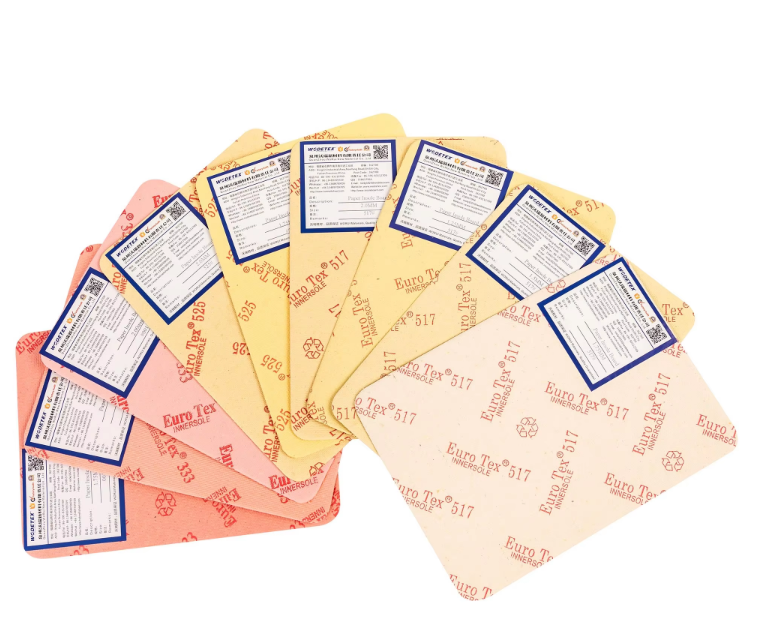
The workhorse of the footwear industry. Paper insole board remains the most widely used board worldwide because it delivers dependable stiffness, clean die-cutting and the lowest cost per pair — without compromising on wear life.
● Thickness range 0.7–2.5 mm — covers everything from light children's shoes to heavy work boots.
● EUROTEX333 brand grade — wearable, durable, and consistent sheet to sheet, which is what matters most on a high-speed cutting line.
● Excellent nail-holding and stapling performance — no splitting at the lasting margin.
● Best for: leather shoes, casual footwear, children's shoes, and any style where cost-per-pair is under pressure.
● Delivery: 7–15 days for full container loads.
Buying tip: If your shoes are lasted wet or stored in humid conditions, move one grade up on water resistance — the small cost difference is far cheaper than a delamination claim.
02 Paper Insole Board + EVA
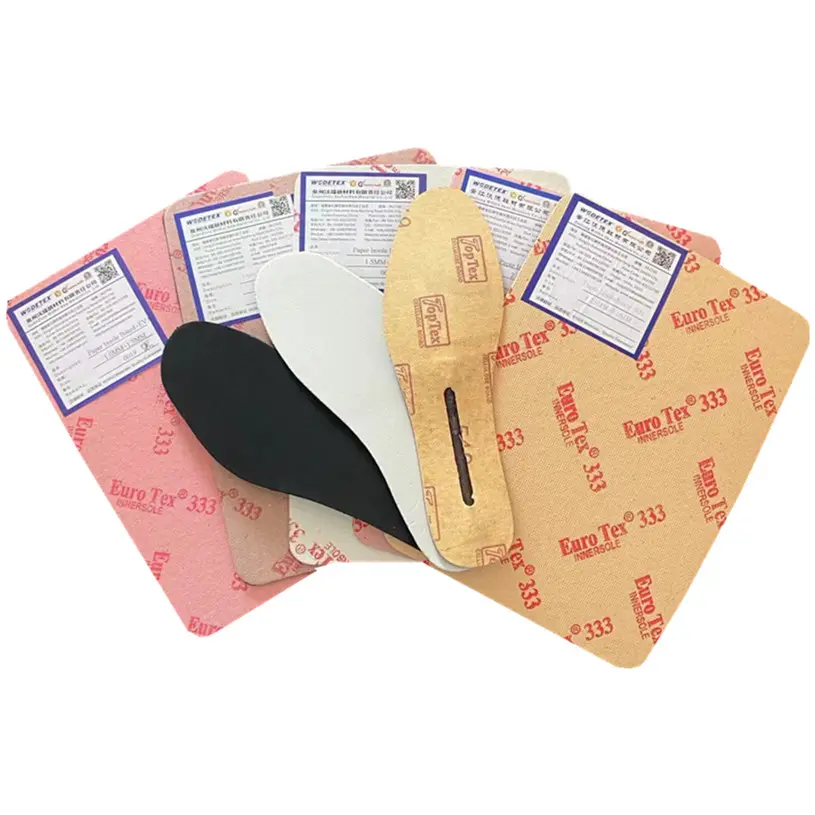
When comfort enters the brief, lamination is the answer. By bonding a layer of EVA foam to the paper substrate, this board adds cushioning and resilience while keeping the dimensional stability that paper provides.
● Laminated construction: paper 1.0–2.0 mm + EVA 1.0–4.0 mm, bonded under controlled heat and pressure.
● Foldable and crack-resistant — the board flexes with the foot instead of fighting it.
● Formaldehyde-free adhesive system, compliant with EU and US restricted substance requirements for footwear.
● Best for: sports shoes, casual sneakers, comfort footwear, and removable insoles.
Buying tip: Specify EVA density alongside thickness. A 3.0 mm low-density EVA compresses faster than a 1.5 mm high-density EVA — thickness alone does not tell you how long the cushioning will last.
03 Nonwoven Insole Board
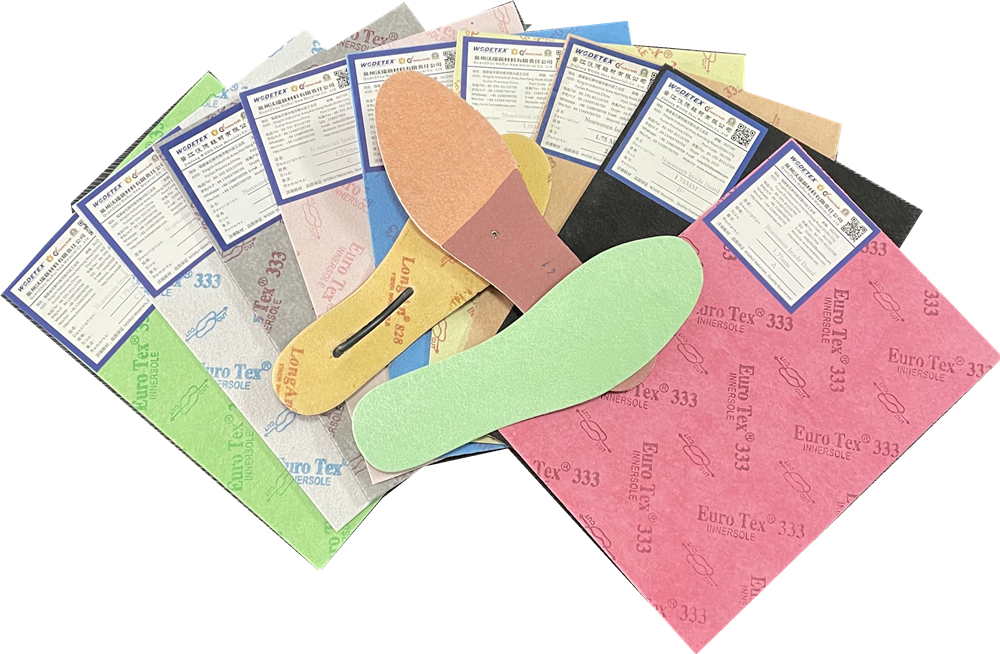
Nonwoven insole board is the colour and sustainability champion of the range. Made from eco-friendly fibres, it is the board of choice when the edge of the board is visible, when the design calls for a specific colour, or when your brand has recycled-content commitments to meet.
● Thickness range 1.0–5.0 mm — the widest range in our insole board line.
● 50+ colours available in stock, with custom shade matching for volume orders.
● Eco-friendly fibre composition, supporting recycled and low-impact material claims.
● Higher grades deliver measurably better waterproofing — grade selection is the main lever for wet-weather footwear.
● Best for: women's shoes, sandals, casual footwear, open-edge designs, and eco-labelled collections.
04 Strobel Insole Board
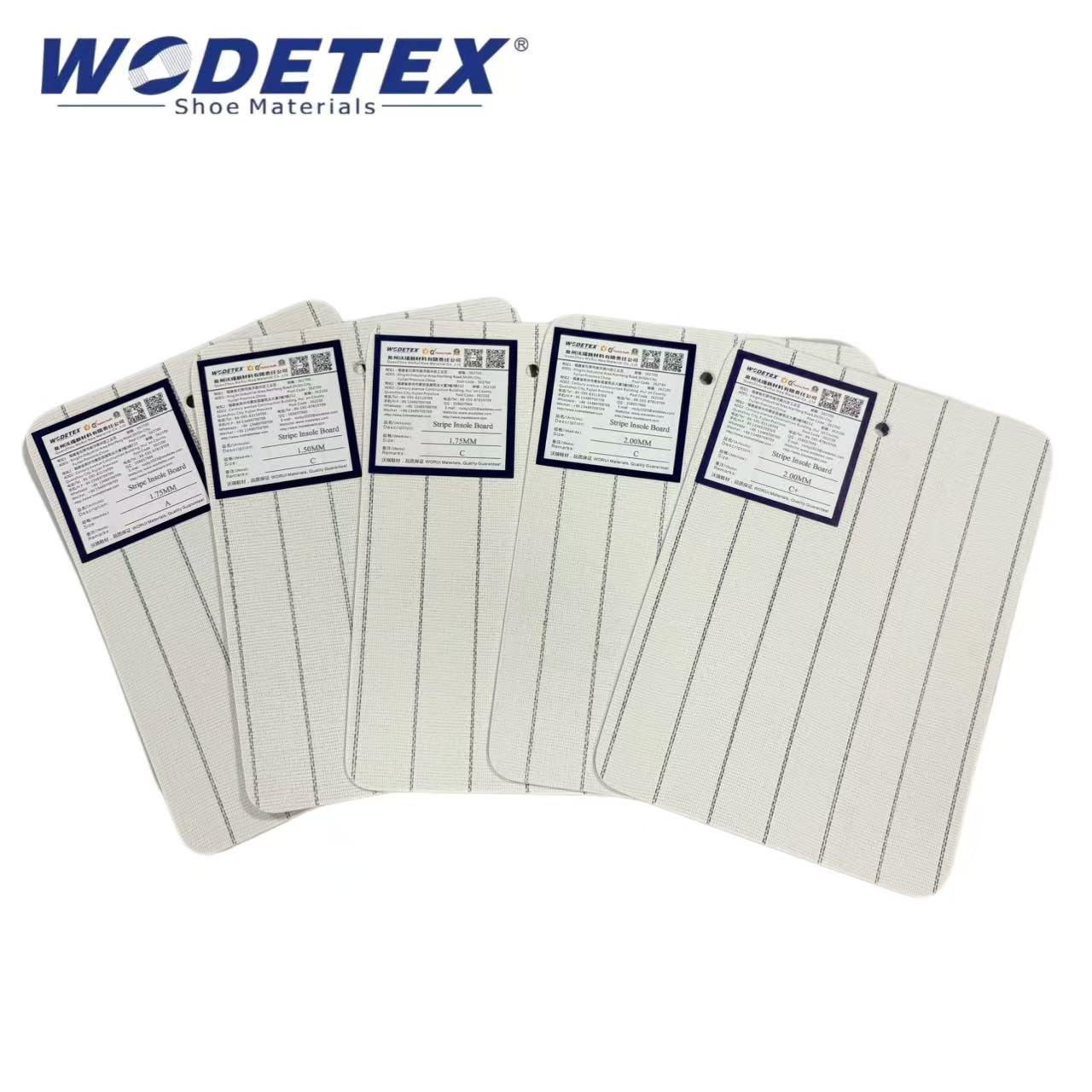
Strobel construction — where the upper is stitched directly to the board — places far higher demands on the material than conventional lasting. The board must accept needle penetration without cracking, resist tearing along the stitch line, and survive repeated flexing.
● Thickness range 0.9–3.0 mm, engineered for needle-punch and strobel stitching.
● Zebra and stripe surface patterns for visual identification on the production line and a cleaner finish inside the shoe.
● Waterproof and crack-resistant, with custom patterns available on request.
● Best for: sports shoes, hiking and work boots, high heels, and any Strobel-stitched construction.
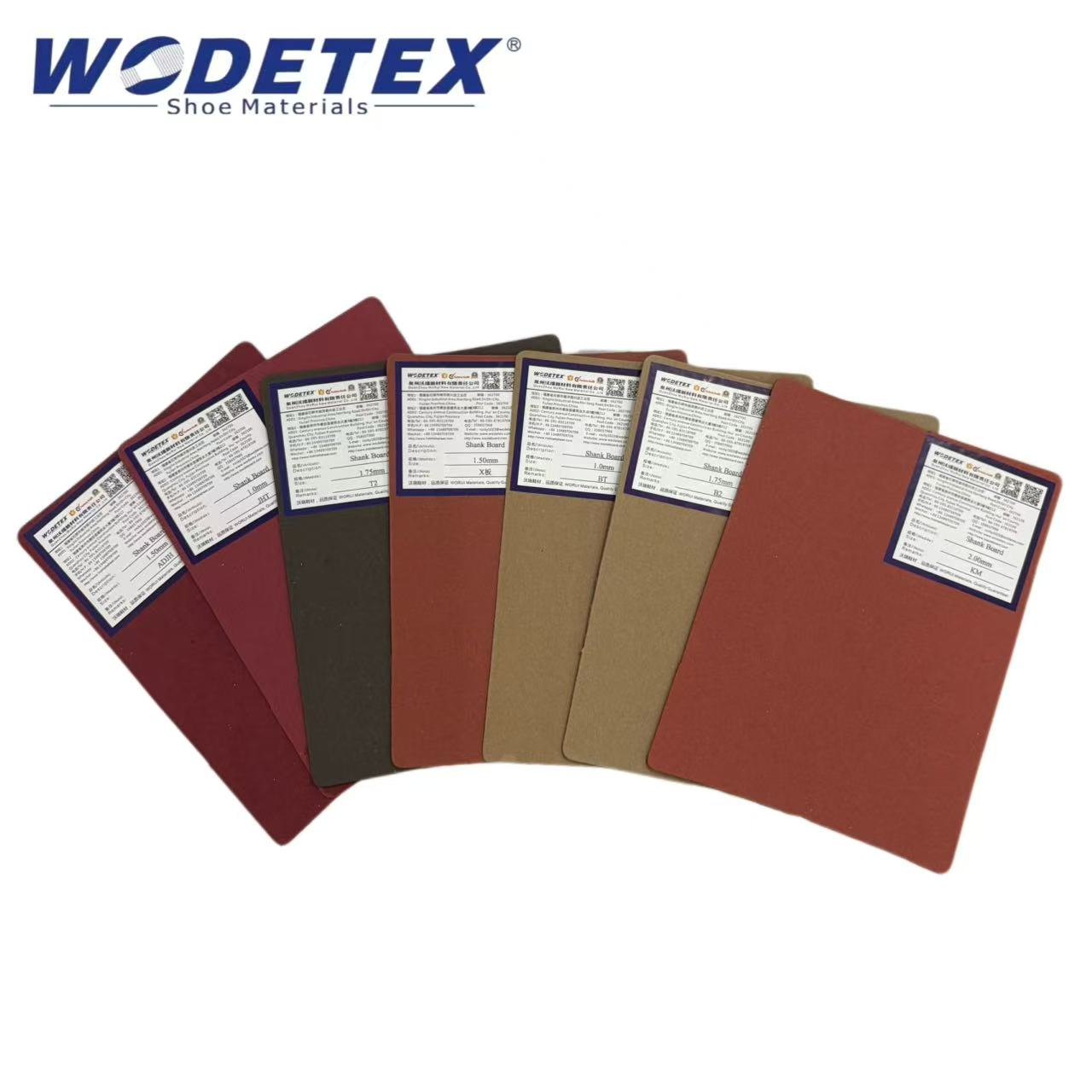
05 Shank Board
The shank board is the structural bridge between heel and forefoot. It prevents the shoe from collapsing in the waist, gives the arch its support, and is the reason a high heel can be worn for hours rather than minutes.
● Thickness range 0.9–3.0 mm, balanced for hardness and controlled flexibility.
● High torsional rigidity — holds the waist shape without becoming brittle.
● Works as a structural reinforcement layer inside the midsole assembly.
● Best for: high heels, boots, work shoes, safety footwear, and any style with a shaped waist.
06 Antistatic Insole Board
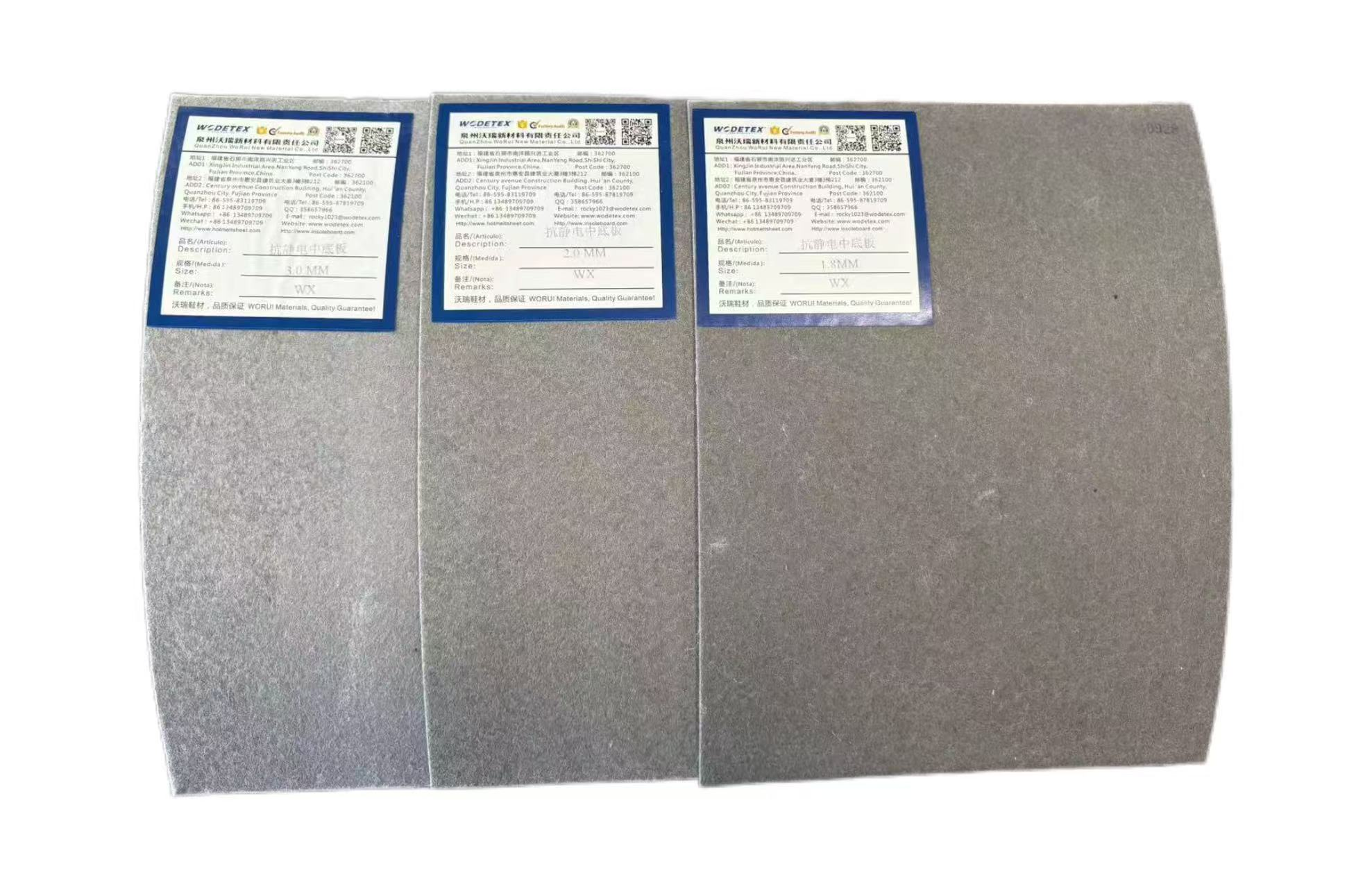
For safety footwear, static dissipation is not a feature — it is a compliance requirement. Our antistatic insole board is formulated to bleed off electrostatic charge through the sole assembly rather than allowing it to build up on the wearer.
● Thickness range 1.25–3.0 mm, engineered for safety shoe construction.
● High tensile strength and excellent peeling resistance — critical when the board is bonded into a certified sole unit.
● Standard colours grey and black, customisable for brand-specific safety lines.
● Best for: safety shoes, industrial work footwear, electronics-factory and cleanroom footwear.
Insole Board Specification Comparison
| Type | Thickness | Key Advantage | Best For | Grades |
| Paper Insole Board | 0.7–2.5 mm | Lowest cost, reliable stiffness | Leather, casual, kids | A / B / C |
| Paper Insole Board+ EVA | Paper 1.0–2.0 + EVA 1.0–4.0 mm | Cushioning + stability | Sports, comfort footwear | Standard / Premium |
| Nonwoven Insole Board | 1.0–5.0 mm | 50+ colours, eco fibres | Women's, sandals, eco lines | Grade-based waterproofing |
| Strobel Insole Board | 0.9–3.0 mm | Stitchable, crack-resistant | Sports, boots, high heels | Zebra / stripe / custom |
| Shank Board | 0.9–3.0 mm | Torsional rigidity | High heels, boots, work | Hardness options |
| Antistatic Insole Board | 1.25–3.0 mm | Static dissipation | Safety footwear | Grey / black |
All specifications are standard ranges. Custom thicknesses, densities, colours and sheet sizes are available on request.
How to Choose the Right Insole Board
Four questions will get you to the right specification faster than any sample book:
● What is the shoe type and heel height? High heels and boots need shank-level rigidity; flat casual shoes do not.
● How is the shoe assembled? Strobel stitching, cement lasting and vulcanisation each punish the board differently.
● What environment will it be worn in? Humidity, sweat and wet ground all push you toward higher waterproofing grades.
● What is your target price point per pair? Our A–D+ grading system lets you match board quality to the retail tier rather than over- or under-specifying.
Frequently Asked Questions
Q1. What is the minimum order quantity? MOQ depends on the board type and whether the specification is stock or custom. Sample and trial orders are welcome — we scale with your business.
Q2. Standard full-container production is 7–15 days. Stock specifications can often ship faster.
Q3. Yes. We support custom thickness, colour, surface pattern, sheet size and logo printing, with OEM/ODM on volume orders.
Q4. Yes. Free samples are available for evaluation — tell us your shoe type and target specification and we will send the closest match.
Why Global Footwear Manufacturers Choose Wodetex
One-Stop Insole Board Supply — from paper board to antistatic board, every insole board type under one roof, with one quality standard and one point of contact.
● Complete Coverage — 6 insole board types, 40+ specifications across our full shoe material range.
● Quality Grading System — multiple grades (A through D+) so you match material cost to your target price point precisely.
● Custom Branding — EUROTEX333 brand or your own logo; full OEM/ODM support.
● Flexible MOQ — from sample orders to full container loads.
● Global Export Experience — serving manufacturers across Asia, the Middle East, Europe and the Americas with T/T, L/C and D/P terms.
● Fast Delivery — 7–15 day production for full containers, keeping your production schedule on track.
Insole Board Specification Comparison
| Type | Thickness | Key Advantage | Best For | Grades |
| Paper Insole Board | 0.7–2.5 mm | Lowest cost, reliable stiffness | Leather, casual, kids | A / B / C |
| Paper Insole Board+ EVA | Paper 1.0–2.0 + EVA 1.0–4.0 mm | Cushioning + stability | Sports, comfort footwear | Standard / Premium |
| Nonwoven Insole Board | 1.0–5.0 mm | 50+ colours, eco fibres | Women's, sandals, eco lines | Grade-based waterproofing |
| Strobel Insole Board | 0.9–3.0 mm | Stitchable, crack-resistant | Sports, boots, high heels | Zebra / stripe / custom |
| Shank Board | 0.9–3.0 mm | Torsional rigidity | High heels, boots, work | Hardness options |
| Antistatic Insole Board | 1.25–3.0 mm | Static dissipation | Safety footwear | Grey / black |
All specifications are standard ranges. Custom thicknesses, densities, colours and sheet sizes are available on request.
How to Choose the Right Insole Board
Four questions will get you to the right specification faster than any sample book:
● What is the shoe type and heel height? High heels and boots need shank-level rigidity; flat casual shoes do not.
● How is the shoe assembled? Strobel stitching, cement lasting and vulcanisation each punish the board differently.
● What environment will it be worn in? Humidity, sweat and wet ground all push you toward higher waterproofing grades.
● What is your target price point per pair? Our A–D+ grading system lets you match board quality to the retail tier rather than over- or under-specifying.
Frequently Asked Questions
Q1. What is the minimum order quantity? MOQ depends on the board type and whether the specification is stock or custom. Sample and trial orders are welcome — we scale with your business.
Q2. Standard full-container production is 7–15 days. Stock specifications can often ship faster.
Q3. Yes. We support custom thickness, colour, surface pattern, sheet size and logo printing, with OEM/ODM on volume orders.
Q4. Yes. Free samples are available for evaluation — tell us your shoe type and target specification and we will send the closest match.
Why Global Footwear Manufacturers Choose Wodetex
One-Stop Insole Board Supply — from paper board to antistatic board, every insole board type under one roof, with one quality standard and one point of contact.
● Complete Coverage — 6 insole board types, 40+ specifications across our full shoe material range.
● Quality Grading System — multiple grades (A through D+) so you match material cost to your target price point precisely.
● Custom Branding — EUROTEX333 brand or your own logo; full OEM/ODM support.
● Flexible MOQ — from sample orders to full container loads.
● Global Export Experience — serving manufacturers across Asia, the Middle East, Europe and the Americas with T/T, L/C and D/P terms.
● Fast Delivery — 7–15 day production for full containers, keeping your production schedule on track.
Post time: Sep-15-2026