
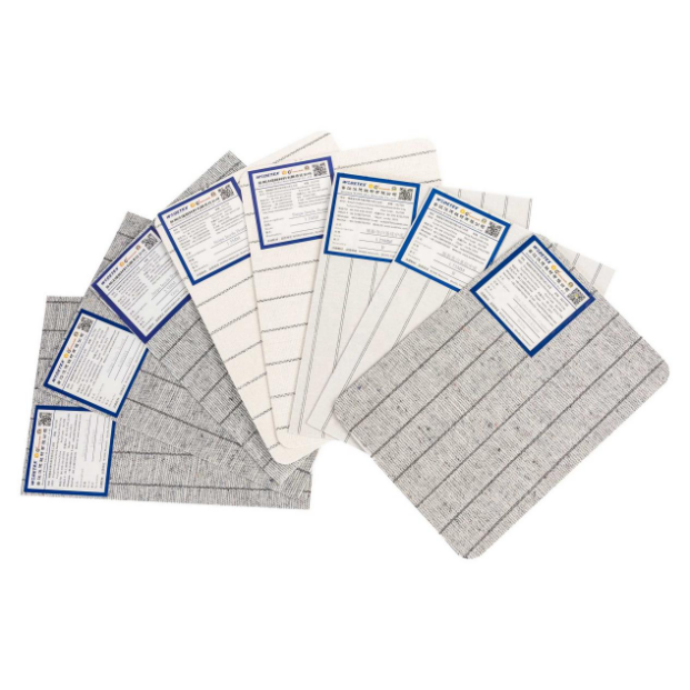
Striped Fiber Board (also known as Striped Midsole Board, Zebra Board, Strobel Board) is a semi-rigid non-woven midsole support material for shoemaking. It is installed between the shoe upper and outsole, featuring parallel stripes on the surface for shaping, tensile resistance and bonding between upper and sole.Made of PET polyester/recycled fibers combined with eco-friendly adhesives via needle punching/spunlacing and hot pressing; versions with wood pulp fibers and latex are also available.The appearances have white base with grey/black stripes (solid white is also available). The stripes act as high-density reinforcing ribs running lengthwise.
Stripe fiber insole board is a high-strength composite base material made of polyester fiber through professional needle-punching and lamination molding processes. Its exclusive parallel striped structure realizes uniform force distribution and excellent structural stability, solving the common problems of traditional insole boards such as easy deformation, brittle fracture and poor air permeability. Compared with conventional shoe base materials, this product features integrated molding, no residue, and excellent compatibility with various adhesives and shoe-making processes. It can perfectly adapt to high-speed assembly line production, meeting the dual needs of manufacturers for efficient production and high-standard finished shoe quality.
Domestic and International Market Development Trends
Domestic Market Status
China, as the world’s largest footwear manufacturing and material supply base, occupies a dominant position in the global stripe fiber insole board market. In recent years, driven by the upgrading of domestic shoe enterprises and the tightening of environmental protection standards, the market demand for high-performance fiber insole boards has maintained steady growth. Domestic manufacturers have continuously optimized production processes, realized independent breakthroughs in core technologies such as fiber blending and striped molding, and gradually reduced reliance on imported high-end base materials. The products are not only supplied to domestic high-end footwear factories, but also exported in large quantities to global markets, forming a complete industrial chain of R&D, production and sales.
International Market Layout
The global stripe fiber insole board market shows a robust upward trend. With the continuous upgrading of consumer demand for footwear comfort and durability, the market size of high-performance shoe base materials has expanded year by year. The Asia-Pacific region, led by China, Vietnam and Indonesia, benefits from the concentrated layout of footwear manufacturing industries and ranks first in global market share, maintaining an annual growth rate of 7%-9%. The European and American markets, with strict product quality and environmental certification standards, have strong demand for eco-friendly, non-deformable fiber insole boards, which are widely used in the supply chains of mainstream brands. The markets in South America and Africa are growing rapidly, as local footwear industries continue to upgrade and raise requirements for supporting materials.
Core Advantages and Key Industry Applications
Core Product Advantages
First, superior structural stability and durability. The unique striped fiber structure enhances the overall tensile and compression resistance of the insole board, effectively avoiding collapse, deformation and layering during long-term wearing, and maintaining stable support performance for a long time.
Second, lightweight and breathable comfort. The porous fiber structure realizes efficient air circulation, reduces foot stuffiness and sweat accumulation, greatly improving the wearing experience.
Third, eco-friendly and safe. The product adopts pure fiber raw materials and physical molding technology, without harmful additives, meeting global environmental protection and textile safety standards. Fourth, strong process adaptability. It fits perfectly with hot pressing, bonding and cutting processes, features high fitting precision and low loss rate, and effectively reduces the comprehensive production cost of shoe factories.
Key Application Scenarios
Stripe fiber insole board is suitable for almost all mainstream footwear types. It is most widely used in sports shoes, providing stable arch support and shock absorption to adapt to high-frequency movement scenarios. In casual shoes and daily walking shoes, it balances lightweight feeling and structural support, realizing long-term wearing comfort. In high-end leather shoes and business shoes, its flat and neat striped texture ensures neat shoe shape and improved grade. In addition, it can also be applied to customized orthopedic shoes and outdoor functional shoes, meeting the differentiated support needs of diverse scenarios.

Industry Policies and Future Prospects
Supported by national green manufacturing and textile quality upgrading policies, the footwear auxiliary material industry is accelerating the elimination of backward and high-pollution materials. High-performance eco-friendly fiber base materials have become the key development direction of the industry. With the continuous upgrading of global consumer awareness of green consumption and footwear functionality, the market demand for stripe fiber insole boards will continue to rise. In the future, the industry will focus on technological innovation, develop ultra-thin high-strength, antibacterial and deodorant upgraded products, and further expand application boundaries. Driven by technological iteration and market demand, stripe fiber insole boards will become an indispensable foundational material for the sustainable development of the global footwear industry.
In conclusion
Stripe fiber insole board stands out in the footwear material market with its comprehensive advantages of stability, comfort, environmental protection and high efficiency. It not only solves the pain points of traditional shoe base materials, but also provides strong support for footwear product upgrading and brand value improvement. Industry manufacturers should keep up with the trend of lightweight and green footwear development, continuously optimize product performance and processing technology, and seize the incremental opportunities of the global high-end shoe material market.
Post time: Jun-15-2026