
Have you ever wondered how many processes a recycled PET bottle must go through before becoming the comfortable and durable shoe lining under your feet?
Today, we step inside the Stitch-bonded cloth production line to document the full journey of an eco-friendly shoe material.
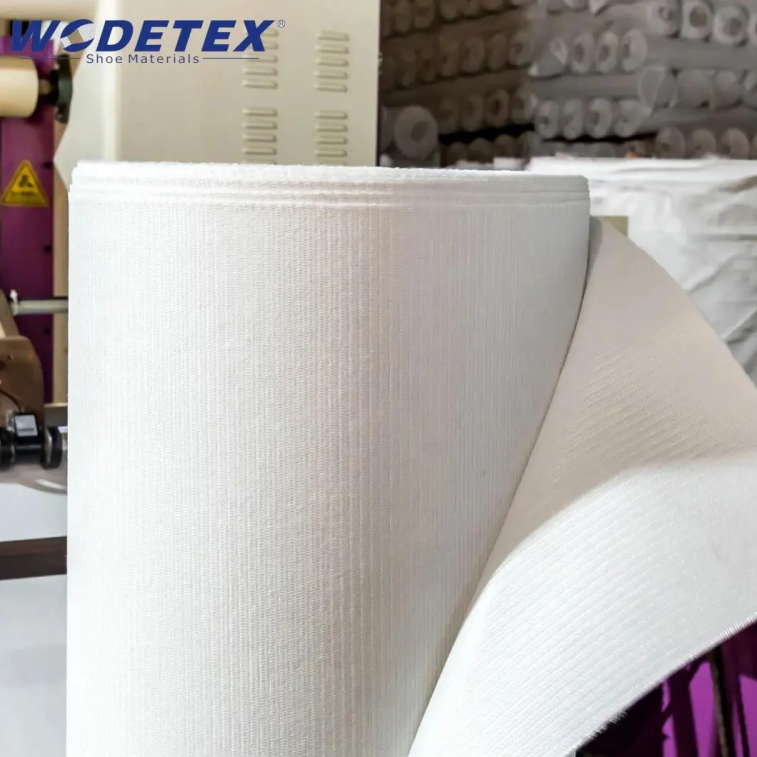
Chapter 1: Material Rebirth
Starting Point: Recycled Plastic Bottles
In the raw material warehouse, bales of recycled polyester staple fiber are neatly stacked. These fibers come from recycled PET plastic flakes, which undergo cleaning, crushing, melting, and spinning to eventually become 4D*65mm polyester staple fiber—the main raw material for Stitch-bonded cloth, accounting for 80% to 95% of its composition.
Sometimes, to impart special properties to the material, low-melting-point fibers are blended in. These fibers act as a “hot melt adhesive” in subsequent processes, allowing for stronger bonding between fibers.
First Stop: Bale Opening and Opening
The massive bale opener opens its “mouth” to break apart the compacted fiber bales. Immediately after, the opener’s needle-covered rollers spin at high speed, combing through the tangled fiber clusters to loosen them. The once-dense fiber bales transform into fluffy fiber tufts, ready for the next step.
Chapter 2: Web Formation
Carding: From Chaos to Order
The fluffy fibers are fed into the carding system, a critical process that determines the uniformity of the material.
The fibers first pass through the pre-cylinder for preliminary carding, then enter the main cylinder. The cylinder surfaces are densely covered with fine needle teeth, rotating at high speed to further separate and parallelize the fibers. The chaotic fibers are here carded into a uniform, lightweight, and directionally arranged fiber web, resembling a thin layer of cotton batting.
Cross-lapping: Layer Upon Layer
A single layer of fiber web is too thin to meet the grammage requirements for shoe materials. The cross-lapper comes into play—it moves back and forth over the bottom curtain, layering the carded fiber webs crosswise. After adjusting the grammage from 65gsm to 300gsm, the fiber layer reaches the required thickness while achieving isotropic mechanical properties.
Chapter 3: Stitch Bonding Reinforcement
Stitch Bonding: Implanting a “Skeleton” into the Fibers
The laid fiber layer enters the stitch bonding area—this is the core process that distinguishes Stitch-bonded cloth from ordinary nonwovens.
The needle bed on the stitch bonding machine is loaded with stitching needles in specifications of 14F, 18F, 22F, or double needle, puncturing thousands of times per minute. High-quality polyester filament yarn accompanies the needles as they penetrate the fiber layer, forming regular warp-knitted loop structures that firmly “lock” the fluffy fibers in place.
This process is like quilting a cotton blanket—except here, the “thread” is high-performance polyester filament, and the “blanket” is the recycled fiber layer. After stitch bonding, the originally loose fiber web transforms into a greige fabric with stable structure.
Optional Needle Punching Reinforcement
For certain special specifications, an additional needle punching process is added. Thousands of needles repeatedly puncture the greige fabric, with barbs driving surface fibers vertically into the interior, creating a three-dimensional network structure that further enhances material density and internal bonding strength.
Chapter 4: Finishing—Giving It Soul
If the previous processes shaped the “body” of Stitch-bonded cloth, then finishing is what gives it a “soul.”
Glue Coating: Determining Hardness and Softness
Depending on the different requirements of shoe materials, the greige fabric enters the coating machine for glue coating treatment. By adjusting the glue formulation and coating weight, the material exhibits different hand feels:
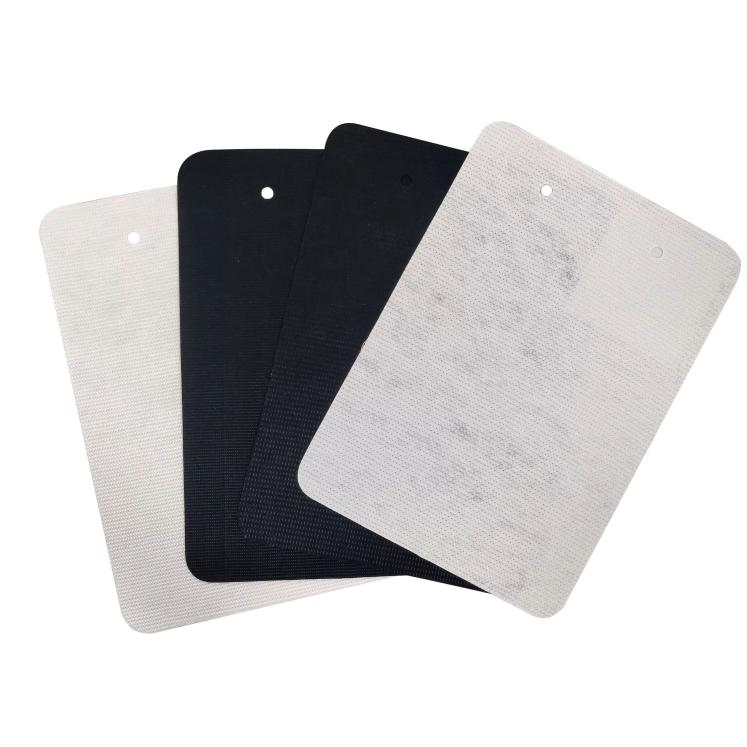
AS Soft Type: Soft and conforming, suitable for tongue lining
AM Medium Type: Moderate support, suitable for upper lining
AH/PH Hard Type:Strong shaping, suitable for toe puffs and heel counters
Functional Finishing: Making the Material Smarter
After heat setting in the stenter machine, the material’s dimensional stability is ensured. Subsequently, based on order requirements, Stitch-bonded cloth may undergo a series of specialized treatments:
Softening and Anti-static Treatment: Makes the fabric surface smooth and soft while preventing static issues
Waterproofing Finish: Imparts water-resistant properties, making it a reliable partner for outdoor footwear
Flame Retardant Treatment: Meets specific safety standards
Absorbent Finish: Enhances moisture absorption for use in specific functional shoe styles
Calendering: Creating the Highlight Moment
Finally, the material passes through high-temperature rollers on the calendering machine. This process not only flattens the fabric surface but also imparts Stitch-bonded cloth with its characteristic glossy appearance—a hallmark of high-end shoe materials and a visual proof of quality.
Chapter 5: Finished Product Delivery
After a series of processes, Stitch-bonded cloth enters the slitting machine to be cut according to customer-required widths. Widths within 2.90 meters can be customized to meet different shoe style requirements.
Quality inspectors randomly select samples to test thickness (0.40mm-1.20mm), grammage, tensile strength, yellowing resistance, high-temperature resistance, acid and alkali resistance, and other indicators. Only when all parameters meet standards can the product proceed to the packaging stage.
On the packaging line, rolls of Stitch-bonded cloth are wrapped in protective film, labeled with specifications, batch numbers, and environmental certification marks. They will be loaded into containers and shipped to shoe factories around the world.
Why Do Shoe Factories Choose Stitch-bonded Cloth?
In the shoe material workshop, the value of Stitch-bonded cloth is evident in every detail:
Toe Puffs and Heel Counters: PH Hard Type provides strong support, maintaining shoe shape durably
Tongue Lining: AS Soft Type offers soft conformability, enhancing wearing comfort
Upper Lining: AM Medium Type provides just the right support—stiff enough yet not abrasive
Outdoor Waterproof Shoes: Seamless overall structure combined with waterproof finish creates a reliable waterproof barrier
Most importantly, its environmental attributes—free from azo dyes, free from heavy metals, compliant with European and American environmental standards—allow brands to tell a compelling sustainability story while pursuing performance.
From Bottle to Shoe: A Complete Rebirth
Looking back at the birth journey of Stitch-bonded cloth, we see not just a series of processes, but a complete value rebirth of materials:
Recycled Plastic Bottles → Recycled Fibers → Carded Web → Stitch Bonding Reinforcement → Functional Finishing → Shoe Material Application
Every roll of Stitch-bonded cloth that leaves the factory carries the dual mission of environmental protection and technological innovation. It is not simply a substitute material, but a vivid practice of the footwear industry’s transition toward a circular economy.
The next time you put on those comfortable sports shoes, think about this—the support beneath your feet might have once been a plastic bottle in your hand.
And all of this begins on the Stitch-bonded cloth production line, with those precision-operated machines and the skilled hands that tend them.
Post time: Mar-17-2026